Not all shade is created equal, and in South Africa, picking the wrong option means either a space that’s too hot to use, a structure that doesn’t survive the wind, or money spent on something that won’t last.
This guide breaks down the Kalahari Shade range honestly in terms of what each product is built for and where it performs best. If you’re trying to figure out which option makes sense for your space, this should help.
Not all woven shade materials are created equal.
Shade netting is a thin, lightweight mesh – the kind you’d install over a vegetable garden or greenhouse to reduce sun intensity on plants. It’s functional for that purpose, but it’s not designed for people. It’s not built to tension properly, it won’t hold up in wind, and it doesn’t create a comfortable shaded space.
Shade sails are a different product entirely. They’re made from thicker, technically engineered fabric. In Kalahari’s case, we use HDPE woven material that is made to block a high percentage of UV, resist tearing, handle wind, and create outdoor spaces that are genuinely cool and comfortable to spend time in.
If you are shading a patio, garden seating area, pool area, or any space where people spend time, a shade sail can be a great solution.


All Kalahari shade products, including our shade sails and umbrellas, are made from HDPE knitted fabric using a special woven construction. That weave is what makes our shade solutions breathable (air moves through, heat doesn’t build up underneath), tear and fray resistant, and easy to maintain. Cleaning is a simple spray-down.
Kalahari is the original shade sail brand in South Africa, and the product range reflects that. It’s built specifically for local conditions, high UV exposure, and long-term outdoor use.
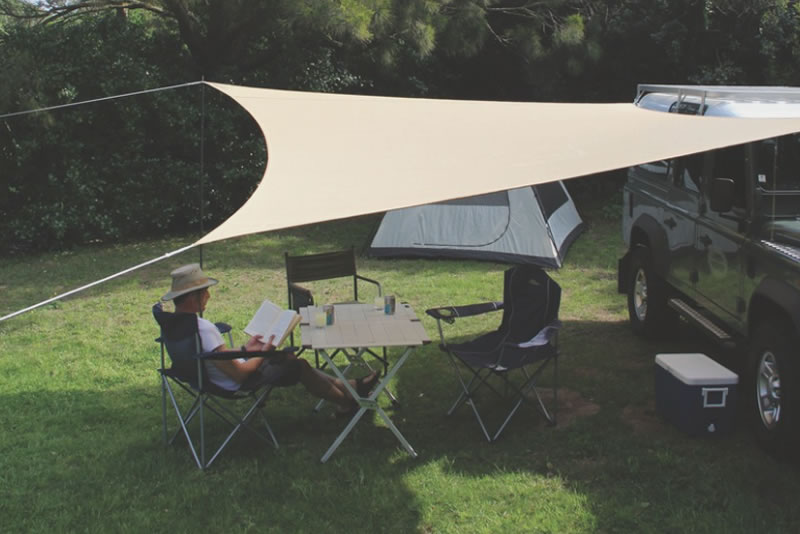
Easy Shade Sails are designed for situations where you need shade that can go up and come down without any permanent fixing. These products come with ropes included and are tied off rather than bolted. No drilling makes it a great renter-friendly solution.
Made from 185 GSM HDPE fabric, the EASY shade sails provide up to 80% UV block and breathe well, so there’s no heat that gets trapped underneath.
Where they work well:
The EASY range carries a 1-year warranty against UV degradation on the fabric.
TLDR: Choose EASY Shade Sails if you need flexibility, you’re renting, or you want a lower-commitment starting point.
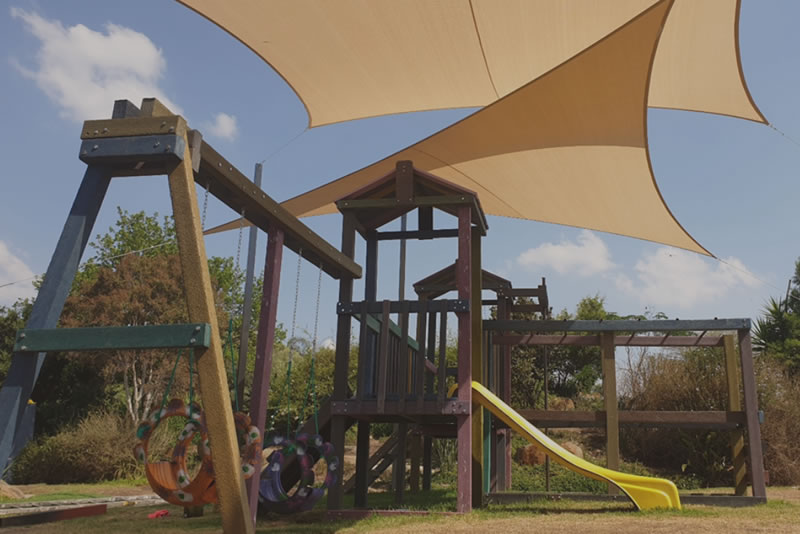
Standard Shade Sails are the go-to for most residential applications. They’re designed to be tensioned and fixed, in other words bolted into walls, poles, or a combination of both, and once they’re up and installed require the minimum maintenance. No need to take the shade down when the weather picks up.
Made from 185 GSM HDPE knitted fabric, the STANDARD range provides up to 90% UV block. Because the fabric is woven rather than solid, air moves through freely. That’s what separates a quality shade sail from a tarpaulin or solid roof — you get real protection without the heat buildup that makes a covered space stuffy and uncomfortable.
The Standard range comes with a 2-year warranty against UV degradation on the fabric.
The shade sails come with marine-grade stainless steel d-links in each corner. Installation requires proper tensioning and solid anchor points. The necessary installation accessories are sold separately (see the installation guide to determine what you need), and recommended installers are available if you’d prefer a professional setup.
TLDR: Choose Standard Shade Sails if you have a fixed patio, garden, or car port that needs reliable everyday coverage.
Extreme Shade Sails use the same installation approach as the Standard range, but the fabric is heavier, with a 280 GSM versus 185 GSM weave, and the construction is designed for more demanding environments.
The EXTREME range still provides up to 90% UV block, but the increased fabric weight means they handle higher wind loads better, hold tension more consistently, and are built for long-term use in exposed or coastal conditions.
The 5-year warranty against UV degradation reflects that durability.
Just like the standard range, the EXTREME shade sails come with marine-grade stainless steel d-links in each corner. Installation requires proper tensioning and solid anchor points. The necessary installation accessories are sold separately (see the installation guide to determine what you need), and recommended installers are available if you’d prefer a professional setup.
TLDR: Choose EXTREME Shade Sails if your space is wind-exposed, coastal, or you simply want the most durable option and plan to leave it up year-round.
Kalahari’s umbrellas are made from the same 185 GSM HDPE knitted fabric as the shade sail range, making it equally breathable, UV-blocking, and easy to clean. Both our MARKET and CANTILEVER options are 3m round and carry a 5-year warranty on the canopy against UV degradation, plus a 6-month manufacturing warranty.
Market Umbrellas use a centre pole with a weighted base (sold separately). Straightforward and effective for outdoor dining tables or a defined seating spot.
Cantilever Umbrellas use a side-arm design, with the pole sitting on the side rather than through the middle of your table or seating area. These umbrellas can be anchored with paving slabs or screwed into the ground, and comes with a rotating foot and adjustable canopy, which is useful as the sun moves through the sky.
These patio umbrellas work well on smaller patios, balconies, next to the pool, outdoor dining areas, and anywhere you want shade you can reposition or angle.
Umbrellas’ limitation is that they cover a smaller footprint than a shade sail meaning they won’t shade surrounding surfaces the way a sail does, and they need to be closed when the wind picks up.
TLDR: Choose an UMBRELLA if you need targeted shade for a specific spot, or want flexible coverage to complement a shade sail over a larger area.
| Easy shade sail | Standard shade sail | Extreme shade sail | Umbrellas | |
| Best for | Portable & temporary use
Balcony, camping, beach |
Fixed everyday shade
Patio, garden, car port |
Tough conditions
Wind, coastal, long-term |
Targeted spot shade
Dining table, balcony, poolside |
| UV block | Up to 80% | Up to 90% | Up to 90% | Up to 90% |
| Fabric | 185 GSM HDPE | 185 GSM HDPE | 280 GSM HDPE | 185 GSM HDPE |
| Breathable | ✓ | ✓ | ✓ | ✓ |
| Hardware | Ropes on each corner | Marine grade stainless steel D-rings
Installation hardware sold separately |
Marine grade stainless steel D-rings
Installation hardware sold separately |
None
Base / pavers sold separately |
| Installation | Ties with ropes
No drilling required |
Bolted & tensioned
Poles or wall anchors |
Bolted & tensioned
Poles or wall anchors |
Centre pole or cantilever
Base or pavers |
| Portable | ✓ | Permanent | Permanent | ✓ |
| Wind resistance | Moderate | Good | High | Must be closed in wind |
| Fabric warranty | 1 year UV | 2 year UV | 5 year UV | 5 year UV
+ 6 month manufacturing |
Browse the full range at the Kalahari Shade shop, or get in touch if you’re not sure what would work for your space.

Find installation guides or connect with our recomended installers for a secure, professional setup
You may be interested in the following articles in the same category
| Cookie | Duration | Description |
|---|---|---|
| cookielawinfo-checkbox-analytics | 11 months | This cookie is set by GDPR Cookie Consent plugin. The cookie is used to store the user consent for the cookies in the category "Analytics". |
| cookielawinfo-checkbox-functional | 11 months | The cookie is set by GDPR cookie consent to record the user consent for the cookies in the category "Functional". |
| cookielawinfo-checkbox-necessary | 11 months | This cookie is set by GDPR Cookie Consent plugin. The cookies is used to store the user consent for the cookies in the category "Necessary". |
| cookielawinfo-checkbox-others | 11 months | This cookie is set by GDPR Cookie Consent plugin. The cookie is used to store the user consent for the cookies in the category "Other. |
| cookielawinfo-checkbox-performance | 11 months | This cookie is set by GDPR Cookie Consent plugin. The cookie is used to store the user consent for the cookies in the category "Performance". |
| viewed_cookie_policy | 11 months | The cookie is set by the GDPR Cookie Consent plugin and is used to store whether or not user has consented to the use of cookies. It does not store any personal data. |